A bathroom asks more of its doors and windows than almost any other room. Privacy is non-negotiable. Ventilation is a functional necessity — moisture, condensation, and humidity need somewhere to go. And yet the bathroom is also a space where natural light matters, where the quality of the fittings shapes how the room feels, and where the daily rituals of getting ready and winding down deserve a considered environment.
Getting this balance right requires careful thought about materials, glass type, and the relationship between the room's size and the openings within it. Browse our gallery below for bathroom door and window combinations that meet all three demands without compromising on any of them.
Explore elegant bathroom spaces crafted with modern windows, premium interiors, and natural lighting aesthetics.

Check out our Frequently Asked Questions. If that doesn’t answer your questions about our products, materials, services, installations, and more, please book a consultation with one of our highly trained service representatives or visit us at any of our Signature Studios.
A bathroom door has to do several things simultaneously: maintain complete privacy, manage moisture without deteriorating, seal well enough to prevent steam from escaping into adjoining spaces, and fit comfortably within what is often a compact layout. Material, seal quality, and the way the door moves are all important considerations.
In rooms where floor space is limited, a sliding bathroom door removes the swing arc that a hinged door requires and keeps the layout clear around fittings. Where a hinged door is preferred, the frame and seal specification matter as much as the aesthetic. Fenesta's range covers both configurations — visit a Signature Studio or speak with a representative to find what suits your bathroom best.
The best doors for a bathroom are those that combine moisture resistance, privacy, and a finish that holds up over time in a consistently humid environment. Both uPVC and aluminium meet these requirements well, and both are significantly more durable in bathroom conditions than timber, which is vulnerable to warping, swelling, and mould over time.
Beyond material, the right door depends on the bathroom's size, the direction it opens, and whether any glazing is required. A bathroom that relies on borrowed light from an adjoining space benefit from a door with a frosted or obscured glass panel. A fully internal bathroom with its own window can accommodate a solid door without any loss of light.
A uPVC bathroom door is one of the most practical specifications for a high-moisture environment. uPVC is completely unaffected by steam and condensation, does not warp or swell, and requires no sealing, painting, or retreating to maintain its performance. The frames are available in a range of colours and finishes — including options that closely resemble timber — so the practical advantages do not come at the cost of appearance.
The insulating properties of uPVC also help reduce condensation on the frame itself, which is a common and persistent problem in bathrooms with limited ventilation. For a room where conditions are consistently demanding, it is a reliable long-term choice.
uPVC bathroom doors are available in a wider range of profiles, finishes, and configurations than many people expect. Solid panels, glazed panels with frosted or textured glass, sliding formats, and hinged formats are all available within Fenesta's uPVC range. Frame colours span white and neutral tones through to darker, more contemporary finishes, and wood-effect options are available for bathrooms where a warmer aesthetic is part of the design intent.
A uPVC bathroom doors design that works well is one where the door integrates with the overall finish of the bathroom — frame colour, glass type, and hardware all considered together rather than selected in isolation. Visit a Signature Studio to see the available combinations in person.
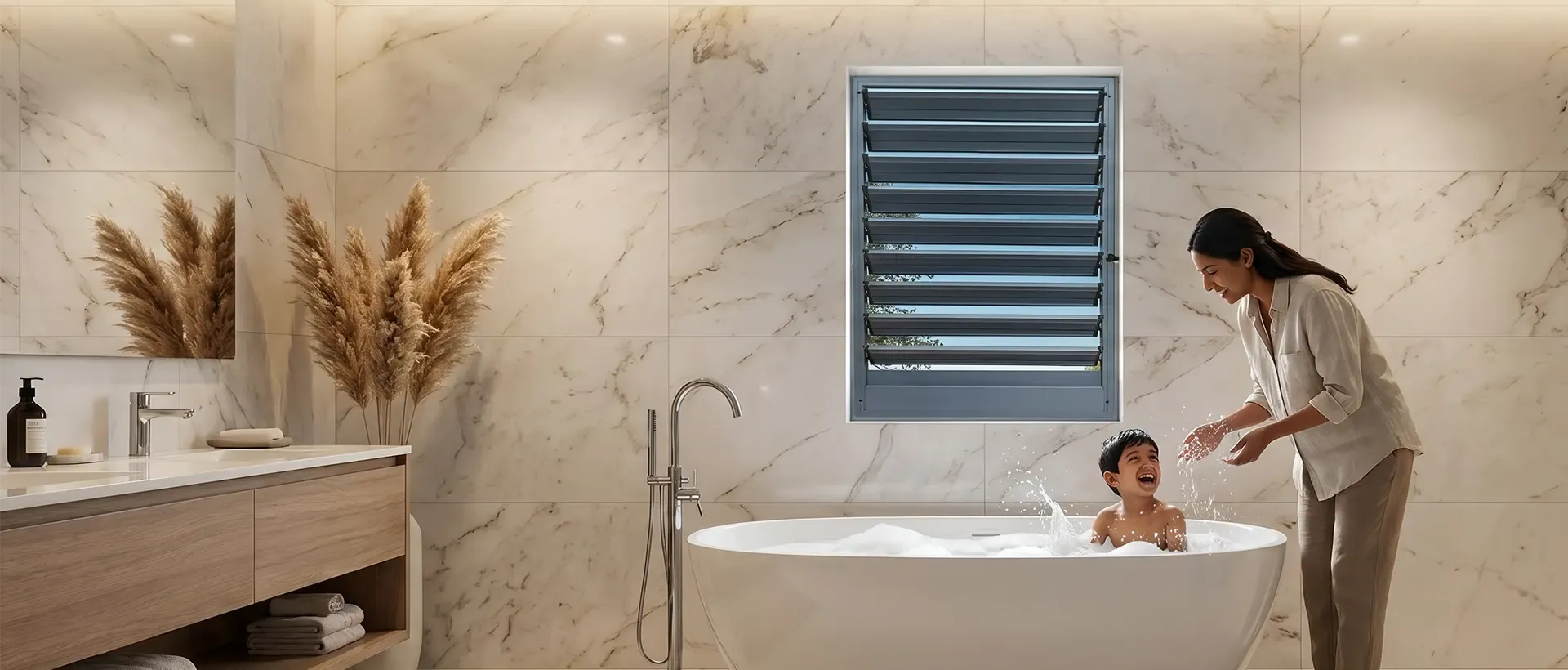
A bathroom window has to resolve a tension that does not exist in most other rooms: the simultaneous need for ventilation and natural light on one hand, and the requirement for complete privacy on the other. The best bathroom windows admit light and allow air to circulate freely while ensuring the interior remains visually screened at all times — whether the window is open or closed.
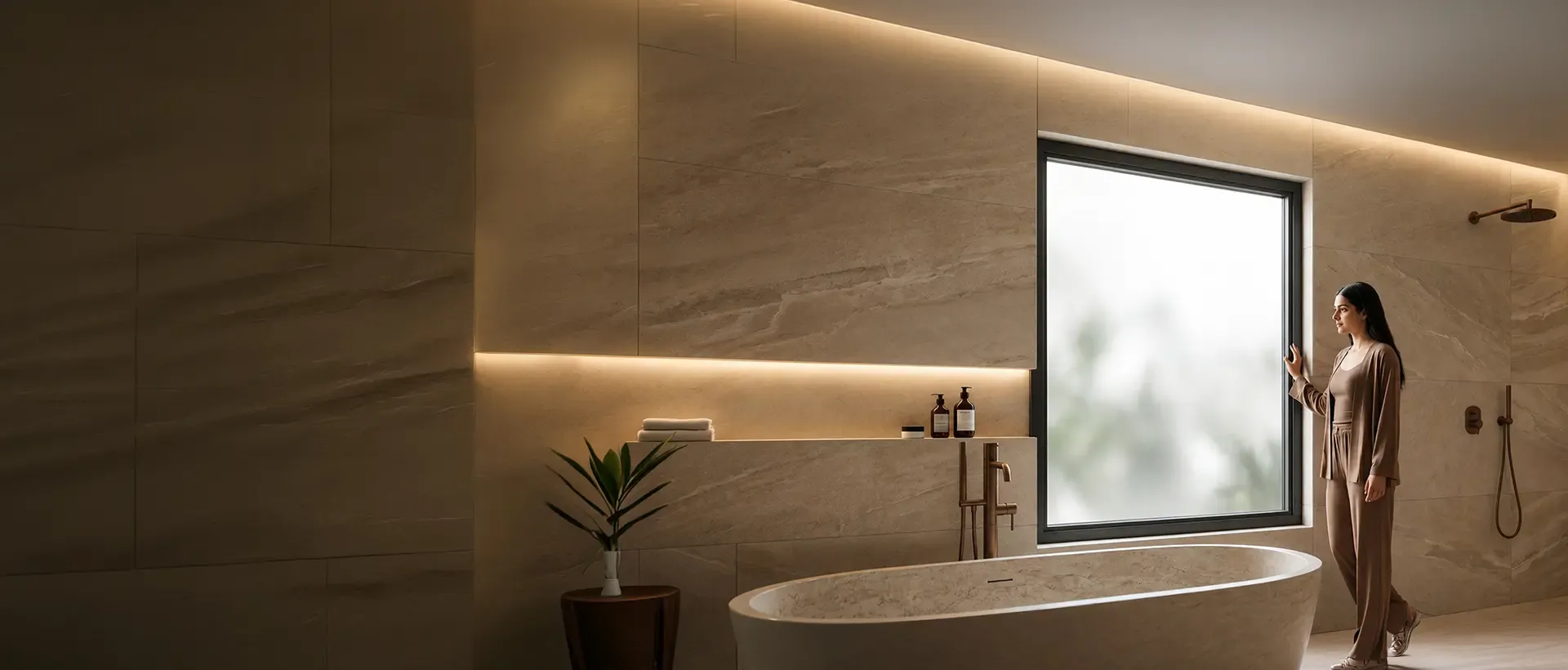
Glass type is the primary tool for achieving this. Frosted, obscured, or textured glass diffuses light beautifully while blocking direct sightlines. The size, position, and opening mechanism of the window determine how effectively it ventilates the room across different conditions.
Choosing the right window for a bathroom starts with understanding the room's ventilation requirements and its relationship to neighbouring properties or shared outdoor spaces. A bathroom that faces a private garden has more flexibility in terms of glass specification than one that faces a street or adjoining building — though obscured glass remains the standard and most straightforward solution in either case.
Top-hung casement windows work well in bathrooms because they allow warm, moist air to escape from the upper part of the room while keeping the lower section closed and private. Slider windows are a good choice where wall space or the external opening is limited. Even a small, well-placed window can significantly improve how fresh and comfortable the room feels day to day.
uPVC windows for a bathroom are among the most practical available. The kitchen and bathroom are the two rooms in the home most affected by moisture and temperature fluctuation, and uPVC handles both conditions without compromise. The frames do not absorb moisture, do not require periodic treatment, and insulate well enough to reduce the condensation that commonly forms on window frames in poorly ventilated bathrooms.
Fenesta's uPVC bathroom windows are available in a range of sizes, opening configurations, and finishes, with obscured glass as standard for privacy. They are designed to perform consistently in the conditions a bathroom produces and to do so with minimal maintenance over the long term.
A good bathroom window design balances four considerations: privacy, ventilation, natural light, and proportion within the wall. In a compact bathroom, a window that is too large can feel exposing even with obscured glass, while one that is too small limits light and air movement more than necessary.
The position of the window relative to the shower, bath, or basin matters too. A window placed above or adjacent to the primary source of steam and moisture ventilates the room most effectively. The frame finish should be considered alongside the fittings and tile palette of the bathroom — a cohesive finish across all elements is what distinguishes a well-designed bathroom from one that simply functions adequately.
Aluminium bathroom windows offer two distinct advantages over other materials. The first is structural: aluminium's strength-to-weight ratio allows for slimmer frames and larger glazed panels, which maximises the amount of light entering a typically compact room without increasing the size of the opening in the wall. The second is durability: aluminium is naturally corrosion-resistant and performs without deterioration in high-humidity environments, requiring no additional treatment or maintenance.
For bathrooms where a contemporary, minimal aesthetic is part of the design intent, aluminium's slim profile and clean lines offer a finish that uPVC cannot replicate. Fenesta's aluminium bathroom window range covers a variety of sizes and configurations to suit different layouts.
Modern bathroom doors are defined by clean lines, minimal hardware, and a considered relationship between solid and glazed surfaces. Flush profiles, slim frames, and finishes in neutral or architectural tones characterise the aesthetic — the door integrates with the bathroom's overall design rather than drawing attention to itself.
In practical terms, modern bathroom doors tend to favour sliding formats for their space efficiency and smooth operation, and frosted or reeded glass panels where light needs to travel between spaces. The emphasis is on quality of material and precision of detail over decorative flourish. Browse our gallery for current examples, or visit a Signature Studio to see the range in person.